Ants
Ant Extermination in Newark, NJ
Pavement ants own Newark sidewalks, odorous house ants trail across kitchen counters, and carpenter ants quietly work the wet wood in old frame houses.
The current page for ants in Newark is here.
Ant extermination in Newark is really three problems with one name. Pavement ants nest under the sidewalks, driveways and slabs and come indoors along the foundation. Odorous house ants trail across kitchen counters after rain. And carpenter ants, the big black ones, tunnel into the damp wood of the city’s older frame houses. Each nests differently, and spraying the trail without finding the nest just moves the problem.
The three ants Newark actually deals with
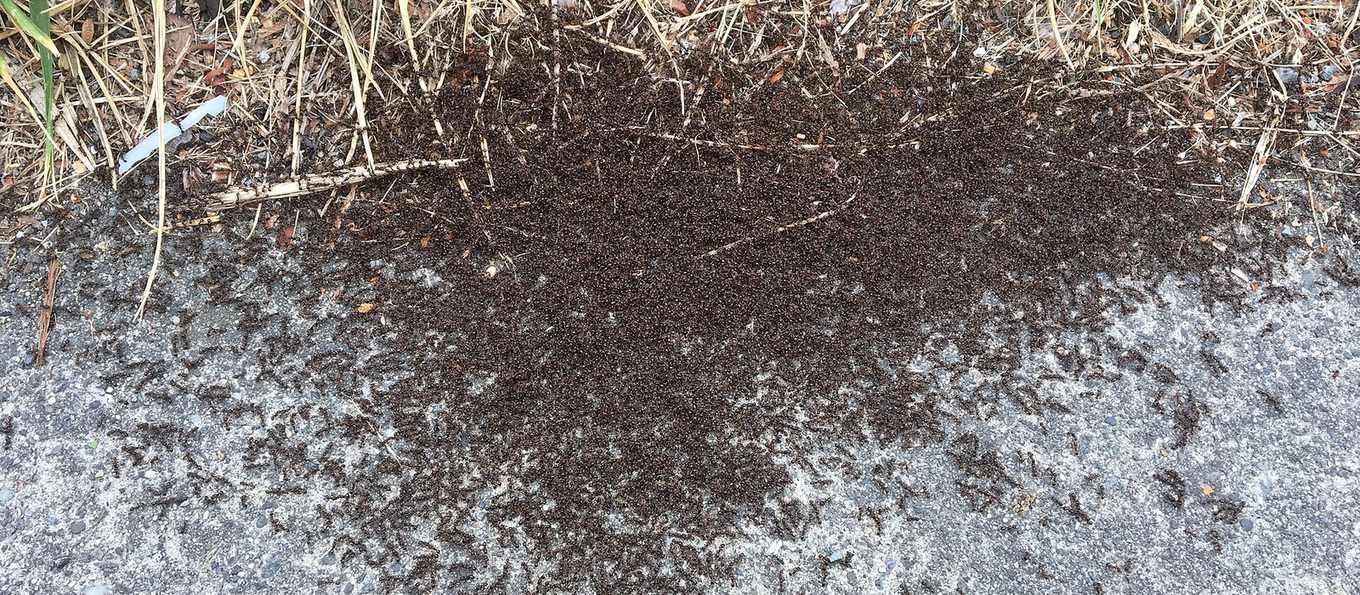
Pavement ants are the small dark ants you see streaming along a sidewalk crack or the edge of a driveway. They nest under concrete and slabs, which a paved-over city has endless amounts of, and they come inside along the foundation and under the door in search of food, especially in spring and after heavy rain floods their nests.
Odorous house ants are the small brown ants that trail across a counter and give off a faint coconut smell when crushed. They love sweets and they love moisture, and in Newark’s wet springs they move indoors and set up in wall voids and under sinks. Carpenter ants are the large black ants, a quarter inch or more, and they are the one to take seriously, because they excavate galleries in wood that is already damp, a leaking window frame, a wet sill, a porch column, a roofline that has been taking water for years.
Reading the trail
The trail you see is the supply line, not the nest. Pavement and odorous house ants can have satellite nests and multiple queens, so killing the workers on the counter does nothing to the colony under the slab or in the wall. Carpenter ants often keep a parent nest outdoors in a tree or stump and a satellite nest inside your wet wood, which is why they seem to appear from nowhere at night.
- A steady line of small dark ants along a sidewalk crack, a slab edge, or the foundation is pavement ant
- Small brown ants trailing to sweets on the counter, with a coconut smell when crushed, are odorous house ants
- Large black ants a quarter inch or more, especially at night, mean carpenter ants and probably wet wood
- A small pile of what looks like sawdust, actually wood shavings, below a window, door frame, or sill points to a carpenter ant nest
- Winged ants indoors in spring can be a mature nest sending out reproductives, or they can be termites, which is worth confirming
How a local exterminator treats ants at the nest
The job is to treat the colony, not the trail. An experienced local exterminator identifies the species, follows the trails to the entry points and the nest, and uses baits the workers carry back to the queen along with targeted treatment of the foundation, the slab edges and the interior voids where they harbor. Spraying a repellent over a visible trail is the classic mistake, it kills the scouts, breaks the colony into satellite nests, and makes the problem bigger.
For carpenter ants the moisture is the real story. Finding and drying the wet wood, the leaking window, the failed flashing, the sill taking water, is what keeps them from coming back, because carpenter ants only move into wood that is already damp. Treatment removes the current nest, moisture correction removes the reason it was there.
Old houses and the water connection
Newark has a lot of century-old wood-frame and mixed-material housing, and ants read every one of them by its moisture. A porch that stays wet, a window that leaks behind the trim, a basement that never fully dries, these are the addresses carpenter ants and odorous house ants keep finding. Fixing the ant problem for good usually means fixing a small water problem the house had anyway.
That is also why ant pressure spikes after Newark’s wet springs and summer storms. Flooded pavement nests push pavement ants indoors, and saturated wood invites the carpenter ants. Timing a treatment before the wet season, and correcting the moisture, is what turns a recurring nuisance into a solved one.
Read more on What pest control costs in Newark and why, or call 973-548-0440 and describe what you are seeing.
Related
People who called about this also called about
Questions
Ants in Newark, answered
Why do the ants come back a few days after I spray them?
Because the spray kills the workers on the trail, not the nest. The queen and the colony are under the slab or in the wall, still producing. Some sprays even split the colony into satellite nests and make it worse. Bait that the workers carry back to the queen is what removes the colony.
Are the big black ants damaging my house?
Carpenter ants excavate galleries in wood that is already damp, so they are both a pest and a signal that a part of the house is staying wet. They do not eat the wood like termites, but they hollow it, and the moisture that drew them is its own problem worth fixing.
How do I tell carpenter ants from termites?
Carpenter ants are larger, dark, with a pinched waist and bent antennae, and they leave coarse wood shavings. Termites are pale, straight-waisted, and leave mud tubes rather than shavings. Winged forms of both swarm in spring, so if you are unsure, a local exterminator can confirm which one you have.
Are the ants coming from my yard or inside the house?
Pavement and odorous house ants usually nest outside, under the slab or in the soil, and forage indoors. Carpenter ants may have a nest indoors in wet wood plus a parent nest outside. Following the trail to the entry point is how the exterminator tells which it is.
Call now
Tell us what you are seeing, and where
Describe the pest, the building and how long it has been going on. You get straight answers and an honest estimate before any work starts. No obligation.
Calls answered 7am to 9pm, seven days a week